
:)
[DL] Coursera: DL Specialization C1W2A2 본문
고양이를 인식하는 로지스틱 회귀 분류기
import numpy as np
import copy
import matplotlib.pyplot as plt
import h5py
import scipy
from PIL import Image
from scipy import ndimage
from lr_utils import load_dataset
from public_tests import *

%matplotlib inline
%load_ext autoreload
%autoreload 2
데이터 개요 및 전처리
# Loading the data (cat/non-cat)
train_set_x_orig, train_set_y, test_set_x_orig, test_set_y, classes = load_dataset()
# Example of a picture
index = 25
plt.imshow(train_set_x_orig[index])
print ("y = " + str(train_set_y[:, index]) + ", it's a '" + classes[np.squeeze(train_set_y[:, index])].decode("utf-8") + "' picture.")y = [1], it's a 'cat' picture.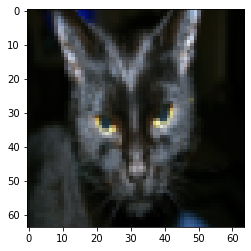
m_train = train_set_x_orig.shape[0]
m_test = test_set_x_orig.shape[0]
num_px = train_set_x_orig.shape[1]
Number of training examples: m_train = 209
Number of testing examples: m_test = 50
Height/Width of each image: num_px = 64
Each image is of size: (64, 64, 3)
train_set_x shape: (209, 64, 64, 3)
train_set_y shape: (1, 209)
test_set_x shape: (50, 64, 64, 3)
test_set_y shape: (1, 50)train_set_x_flatten = train_set_x_orig.reshape(train_set_x_orig.shape[0], -1).T
test_set_x_flatten = test_set_x_orig.reshape(test_set_x_orig.shape[0], -1).Ttrain_set_x_flatten shape: (12288, 209)
train_set_y shape: (1, 209)
test_set_x_flatten shape: (12288, 50)
test_set_y shape: (1, 50)train_set_x = train_set_x_flatten / 255.
test_set_x = test_set_x_flatten / 255.
*새로운 데이터 집합의 전처리를 위한 일반적인 단계
1) 문제의 크기와 모양 파악
2) 데이터 집합 재구성
3) 데이터 표준화하기
알고리즘 구성
def sigmoid(z):
    s = 1 / (1 + np.exp(-z))
    return s
def initialize_with_zeros(dim):
w = np.zeros((dim, 1))
b = 0.0
return w, bdef propagate(w, b, X, Y):
m = X.shape[1]
Z = np.dot(w.T, X) + b
A = sigmoid(Z) # A is the sigmoid of Z
cost = (-1 / m) * np.sum(Y * np.log(A) + (1 - Y) * np.log(1 - A))
dw = (1 / m) * np.dot(X, (A - Y).T)
db = (1 / m) * np.sum(A - Y)
cost = np.squeeze(np.array(cost))
grads = {"dw": dw,
"db": db}
return grads, costdef optimize(w, b, X, Y, num_iterations=100, learning_rate=0.009, print_cost=False):
w = copy.deepcopy(w)
b = copy.deepcopy(b)
costs = []
for i in range(num_iterations):
grads, cost = propagate(w, b, X, Y)
# Retrieve derivatives from grads
dw = grads["dw"]
db = grads["db"]
w = w - learning_rate * dw
b = b - learning_rate * db
# Record the costs
if i % 100 == 0:
costs.append(cost)
# Print the cost every 100 training iterations
if print_cost:
print ("Cost after iteration %i: %f" %(i, cost))
params = {"w": w,
"b": b}
grads = {"dw": dw,
"db": db}
return params, grads, costsdef predict(w, b, X):
m = X.shape[1]
Y_prediction = np.zeros((1, m))
w = w.reshape(X.shape[0], 1)
# Compute vector "A" predicting the probabilities of a cat being present in the picture
A = sigmoid(np.dot(w.T, X) + b)
for i in range(A.shape[1]):
# Convert probabilities A[0,i] to actual predictions p[0,i]
if A[0, i] > 0.5:
Y_prediction[0, i] = 1
else:
Y_prediction[0, i] = 0
return Y_prediction
def model() : 모델을 학습시키고 예측 작업 수행
X_train, Y_train : 훈련 데이터, 레이블
X_test, Y_test : 테스트 데이터, 레이블
num_iterations : 반복 횟수
learning_rate : 학습률
print_cost : 비용을 출력할지 여부를 결정
def model(X_train, Y_train, X_test, Y_test, num_iterations=2000, learning_rate=0.5, print_cost=False):
    w, b = initialize_with_zeros(X_train.shape[0])

    params, grads, costs = optimize(w, b, X_train, Y_train, num_iterations, learning_rate, print_cost)

    # 가중치와 바이어스 업데이트
    w = params["w"]
    b = params["b"]

    # 예측 수행
    Y_prediction_test = predict(w, b, X_test)
    Y_prediction_train = predict(w, b, X_train)

    # Print train/test Errors
    if print_cost:
        print("train accuracy: {} %".format(100 - np.mean(np.abs(Y_prediction_train - Y_train)) * 100))
        print("test accuracy: {} %".format(100 - np.mean(np.abs(Y_prediction_test - Y_test)) * 100))


    d = {"costs": costs,
         "Y_prediction_test": Y_prediction_test,
         "Y_prediction_train" : Y_prediction_train,
         "w" : w,
         "b" : b,
         "learning_rate" : learning_rate,
         "num_iterations": num_iterations}

    return d
모델을 학습시키고 예측하는 작업을 수행
logistic_regression_model = model(train_set_x, train_set_y, test_set_x, test_set_y, num_iterations=2000, learning_rate=0.005, print_cost=True)Cost after iteration 0: 0.693147
Cost after iteration 100: 0.584508
Cost after iteration 200: 0.466949
Cost after iteration 300: 0.376007
Cost after iteration 400: 0.331463
Cost after iteration 500: 0.303273
Cost after iteration 600: 0.279880
Cost after iteration 700: 0.260042
Cost after iteration 800: 0.242941
Cost after iteration 900: 0.228004
Cost after iteration 1000: 0.214820
Cost after iteration 1100: 0.203078
Cost after iteration 1200: 0.192544
Cost after iteration 1300: 0.183033
Cost after iteration 1400: 0.174399
Cost after iteration 1500: 0.166521
Cost after iteration 1600: 0.159305
Cost after iteration 1700: 0.152667
Cost after iteration 1800: 0.146542
Cost after iteration 1900: 0.140872
train accuracy: 99.04306220095694 %
test accuracy: 70.0 %# Example of a picture that was wrongly classified.
index = 1
plt.imshow(test_set_x[:, index].reshape((num_px, num_px, 3)))
print ("y = " + str(test_set_y[0,index]) + ", you predicted that it is a \"" + classes[int(logistic_regression_model['Y_prediction_test'][0,index])].decode("utf-8") + "\" picture.")y = 1, you predicted that it is a "cat" picture.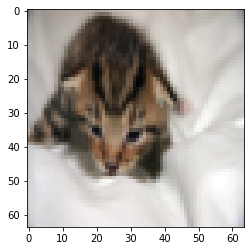
모델 학습 과정에서 cost 변화 시각화
# Plot learning curve (with costs)
costs = np.squeeze(logistic_regression_model['costs'])
plt.plot(costs)
plt.ylabel('cost')
plt.xlabel('iterations (per hundreds)')
plt.title("Learning rate =" + str(logistic_regression_model["learning_rate"]))
plt.show()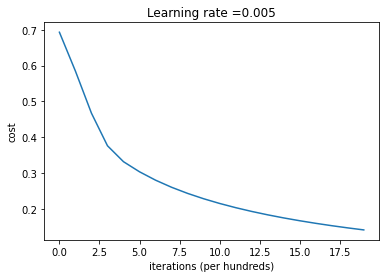
'AI' 카테고리의 다른 글
| [LLM] Large Language Model (3) | 2024.09.13 |
|---|---|
| [DL] Coursera: DL Specialization C2W1A1 (1) | 2024.09.07 |
| [DL] Coursera: DL Specialization C1W4A2 (1) | 2024.08.30 |
| [DL] Coursera: DL Specialization C1W4A1 (0) | 2024.08.27 |
| [DL] Coursera: DL Specialization C1W3A1 (0) | 2024.08.16 |
'AI' Related Articles
more


